What Decides Who Pays When Borrowed Jewelry Worth $8.2 Million Leaves the Vault
Jewelers lend award-night pieces, and loan contracts, insurance and security decide who answers for a loss once a piece leaves the vault.
Many of the jewels worn on award nights are borrowed. A 2013 MoneyWatch report published on CBS News says many jewels, gowns and watches worn on Oscar night are on loan. The values can be very large. Chubb’s account says jeweler Lorraine Schwartz may have asked Sandra Bullock to wear diamond earrings and a bracelet worth $8.2 million.
Once a piece leaves the jeweler, the question of who pays for a loss is answered by three things: the loan agreement, insurance and security. The sources below describe how those three fit together, and where they differ.
How the Loan Is Documented Before the Event
Celebrity loans are arranged in advance and put in writing. According to the CBS News report, stars sign written agreements to borrow gowns, jewelry and watches for Oscar night. The agreements require them to return the items in good condition, and they can be held financially responsible if something goes wrong.
In the Fox Business jewelry feature, based on interviews with jewelers and underwriters, celebrities sometimes purchase the pieces they borrow, though the article says this is not the norm. Jorge Adeler, a custom jeweler, says all the pieces celebrities wear were made for his clients, not for the celebrities.
A Sublimit Example
MoneyGeek’s illustration pairs a $50,000 personal property limit with a $1,500 jewelry sublimit, so in that illustration a stolen $6,000 bracelet would pay $1,500.
Who Insures a Piece While It Is on Loan
The jeweler’s policy does not always run through the event. In the Fox Business feature, Adeler says his insurance covers a loaned piece only until it reaches the celebrity, who is then responsible. The same article quotes Janece White, vice president and jewelry underwriting specialist for Chubb Group of Insurance Companies. The article says the block policies of firms such as Harry Winston or Tiffany may extend to items on loan or consignment.
Chubb’s page points the other way. In its Bullock example, Chubb says the jeweler did not insure the earrings and bracelet while Bullock wore them, so responsibility fell to the borrower. The two accounts differ on whether a jeweler’s policy follows a loaned piece.
When the jeweler’s insurer is involved, the Fox Business feature says it typically requires either proof of valuable articles coverage or a signed agreement assuming financial responsibility for loss, damage or theft. White says that if the celebrity already has jewelry coverage, their insurer may be able to extend its limits to cover the event. Otherwise, White says, they would have to buy short-term coverage from a broker through a syndicate like Lloyd’s of London, which would be very expensive.
Transport, Storage and the Handoff
Underwriters review how a piece is picked up, transferred, kept overnight and returned, according to the Fox Business feature. Security guards sometimes handle transport, and an underwriter can require changes to the plan. The article says the underwriting decision often boils down to the celebrity.
White says she would not insure someone she considers unethical. She also says she is a little more nervous underwriting the Grammys and MTV Video Music Awards than the Emmys or Oscars, and that it is “a different crowd coming to see them.”
The CBS News report says celebrities typically insure borrowed jewelry and hire bodyguards to protect them on the way to events.
Chubb uses a 2014 Oscars example. It says Jennifer Lawrence wore a diamond necklace, earrings and ring valued at $3.5 million, and that the jewelry was not kept in a hotel room safe. Chubb advises keeping valuables in a bank vault or the hotel’s main safe, because room safes may be accessible to many people. The lender is not named.
Chubb also says clasps can break and earrings can come loose, and that a valuable-articles policy can cover a broken piece or a single lost earring.
What a Homeowners Policy Pays for a Piece
A wearer’s own homeowners policy usually has a separate, lower limit for jewelry theft. MoneyGeek’s guide, updated October 9, 2026, gives an example of a $50,000 personal property limit with a $1,500 jewelry sublimit. In that illustration, a stolen $6,000 bracelet would pay $1,500, leaving $4,500 for the owner to cover. The guide says a larger personal property limit does not raise the jewelry payout. Chubb says standard homeowners coverage typically offers limited protection for valuables such as jewelry.
Sublimits vary by insurer and are listed on the declarations page or in the policy’s special limits section. MoneyGeek also describes a pair-and-set clause, which pays only a proportional share of a loss. Its example is that one earring from a $2,000 pair usually pays $1,000.
A scheduled endorsement, also called a personal articles floater or rider, lists individual pieces up to set amounts. According to MoneyGeek, it usually adds coverage for accidental loss and mysterious disappearance, which standard policies exclude. Most insurers require a recent appraisal to add or update a scheduled endorsement.
MoneyGeek warns that an older appraisal may not reflect current market value, especially for gemstones. It says a certified gemologist’s appraisal carries the most weight in a claim. Purchase receipts, photos and grading certificates can also support a claim, according to the guide.
Once a piece leaves the jeweler, the question of who pays for a loss is answered by three things: the loan agreement, insurance and security.
What the Award-Night Values Measure
Chubb lists several award-night pieces by value. Anne Hathaway wore a $10 million Tiffany diamond necklace and drop earrings at the 2011 Academy Awards. Charlize Theron wore a $15 million Harry Winston necklace with a 39-carat emerald-cut diamond at the 2014 Oscars. Beyoncé wore a $12 million diamond necklace at the 2017 Grammys. Chubb says it was held together by a mere clasp, and that she was wise to take it off when she performed. Chubb does not say whether the Hathaway or Beyoncé pieces were borrowed.
The CBS News report says Carrie Underwood reportedly wore a $31 million, 381-carat diamond necklace to the Grammys and was reportedly afraid that someone would tackle her over it. The report does not say who owned the necklace.
How Often Losses Happen and What They Involve
White says there have been no claims on borrowed items, though some large events have produced claims, usually for earrings or bracelets that fell off.
White lists the biggest causes of loss as mysterious disappearance, unknown theft and inside jobs. She says stick-up robberies are less common with high-net-worth clients.
Chubb says jewelry is more often misplaced than stolen.
The CBS News report describes a dispute over about $100,000 in jewelry. The wearer claimed the pieces were lost in transit while being returned to the jeweler after a 2010 charity event. The jeweler had originally won a $113,000 judgment. The case was settled, and neither side disclosed the settlement amount.
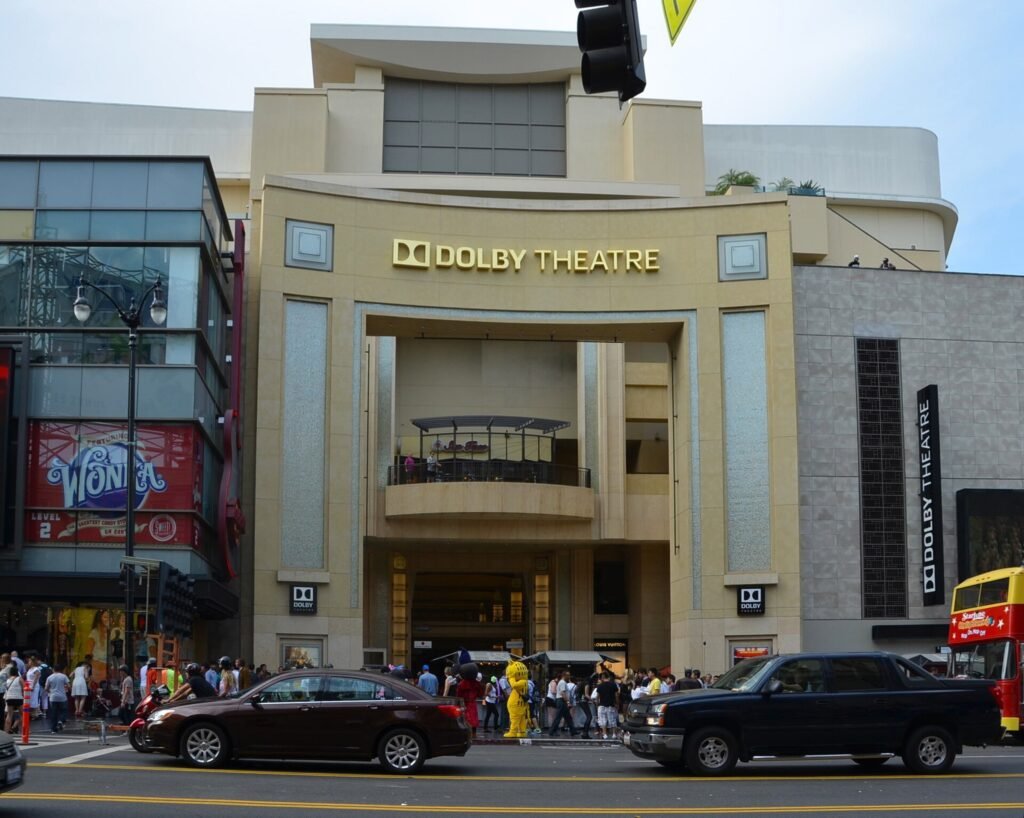
Photo: File:Dolby_Theatre.jpg : Adam Fagen from Washington, DC, USA derivative work: Ju · CC BY-SA 2.0 · via Wikimedia Commons