/https://tf-cmsv2-smithsonianmag-media.s3.amazonaws.com/filer_public/27/3a/273a8296-6d2b-4dcc-a0cc-84cb7c488389/photo_2.jpg?ssl=1 "Seals Are Seemingly Vanishing Off the Dutch Coast. These Scientists Are Trying to Get to the Bottom of the Mysterious Disappearances")
Seals Are Seemingly Vanishing Off the Dutch Coast. These Scientists Are Trying to Get to the Bottom of the Mysterious Disappearances
Recent counts of the Wadden Sea’s adult harbor seal population have revealed a surprising trend of decline, prompting a consortium of researchers to investigate whether the animals are dying off, relocating or experiencing something else altogether
:focal(1970x1116:1971x1117)/https://tf-cmsv2-smithsonianmag-media.s3.amazonaws.com/filer_public/27/3a/273a8296-6d2b-4dcc-a0cc-84cb7c488389/photo_2.jpg)
A juvenile harbor seal lies on a beach in the Netherlands.
Janis Meyer / Waddenagenda
Amid floating beer cans and discarded bicycles, a juvenile harbor seal was seen swimming through the canals of Amsterdam on September 18. The animal had left its herd in the Wadden Sea—which straddles the northern coastlines of the Netherlands, Germany and Denmark—and strayed inland, evoking a mix of delight and worry from passersby wherever it emerged.
Sander van Dijk, a biologist and head of content and programming at Pieterburen, one of the largest seal rehabilitation centers in Europe, spent much of the day informing reporters and concerned citizens that there was, in fact, no cause for alarm. “It doesn’t happen often,” he says, “but it does happen. Once, a ringed seal—not even a Dutch species—traveled all the way to Utrecht,” a city located even farther away from shore.
Per Dutch law, organizations like Pieterburen can intervene only when a seal is wounded or in danger, and this young seal, nicknamed “Uutje,” appeared to be neither. Harbor seals are excellent scavengers and navigators that can survive in both salt and fresh water. They’re also curious and unpredictable, especially in their youth. Van Dijk recalls a study that tracked another youngling during its migration: “Instead of reaching Morocco via Spain, it swam straight into the Atlantic Ocean and kept going until they lost signal.” What happened to it is anyone’s guess.
Harbor seals are the most widely distributed seals in the world, found along shorelines from the Arctic to Mexico. In the Netherlands, they’re most abundant in the largely predator-free Wadden Sea, where intertidal sandbanks provide ample space for resting and raising pups. But while young Uutje’s case was a lighthearted story that grabbed residents’ attention, experts say a wider and potentially more disturbing trend has been playing out across the local seal population.
Once critically endangered, the Wadden Sea’s harbor seals recovered significantly after local governments banned hunting in the 1960s and ’70s: From 1975 to 2023, their estimated population rose from less than 5,000 to roughly 33,300. Now, however, after decades of upward progression, the tide has started to turn once more.
Quick fact: The Wadden Sea
The Wadden Sea, declared a UNESCO World Heritage Site in 2009, is the world’s largest continuous intertidal system of sand and mud flats. But a report last year found that it has been poorly preserved, with 38 percent of indicators for climate, habitat and biodiversity falling behind reference values.
Between 2020 and 2021, the estimated number of harbor seals began to shrink. Barring two deadly distemper epidemics in the 1980s and early 2000s, it was the first major population drop since researchers had begun counting—and it carried over into the following years. Now the seals have seen a downward trend of around 4 percent per year on average since 2020.
At a glance, this trend appears to be age-related, because although the total number of seals is lower than usual, the number of pups being born recently rose. A 2025 report described the “second highest pup count ever,” after lower than usual pup counts from 2022 to 2024. But even with all the pups, which were counted in June, the total population had, by August, grown by only 1 percent since August 2024. “The survey results indicate a population under pressure,” according to the latest report, “and a high pup mortality.”
“This is almost certainly not a measurement error or natural fluctuation,” says David Goldsborough, a senior lecturer in marine policy at Van Hall Larenstein University of Applied Sciences in the Netherlands. He’s leading a two-year research consortium on behalf of the Dutch Ministry of Agriculture, Fisheries, Food Security and Nature, which aims to figure out what’s happening and why. “We are missing significant portions of the population. All those pups—we completely lose sight of them, and that’s just strange. We know something is up, but not what.”
Whatever it is, it’s probably not relocation. “Harbor seals could theoretically leave the area for better places,” says Robbie Weterings, a marine ecologist at Van Hall involved with the consortium. “But there are no signs of increasing numbers elsewhere. They also have high site-fidelity: They like to come back to the same spot year after year. Instead, we can assume that the pups are simply not making it.”
Why they are not making it is another question altogether. The consortium is investigating a number of hypotheses, some more convincing than others. If another distemper outbreak is underway, for instance, Pieterburen’s head of veterinary science, Ana Rubio-Garcia, has yet to see its signs. Although fewer pups have ended up in her team’s care as of late, most suffer from common, easily treatable afflictions like parasitic pneumonia. Nothing out of the ordinary.
The nature of the decline itself also points in a different direction from distemper. The previous two outbreaks, which quickly took out more than half the total population, “were very abrupt declines, followed by abrupt recoveries,” says Weterings. “This time, the numbers are dropping slowly and gradually, year by year.”
Other possible explanations have also been ruled out. “It could be that we’ve reached the maximum capacity of harbor seals this ecosystem can take,” says Goldsborough, “but then we’d see similar trends with other species, like the gray seal, and we don’t.”
Another possibility is that the gray seal is responsible for the harbor seal’s decline. According to Weterings, gray seals are known to feed on harbor seal pups. The former’s growing population, paired with a reduction in other food sources, could motivate them to prey on their smaller cousins—and it would explain why experts are not seeing more dead pups wash ashore.
Goldsborough and Rubio-Garcia aren’t too sure about this possibility, though. The seals treated at Pieterburen occasionally have corkscrew-shaped scars, indicating close encounters with gray seals, but this sight has not become more common. Further, if gray seals were responsible for the harbor seal’s decline, the decline would be most pronounced in areas where gray seals are most plentiful, but that is not the case.
Seals haul out onto land during the molting season in the Wadden Sea. © Emilie Stepien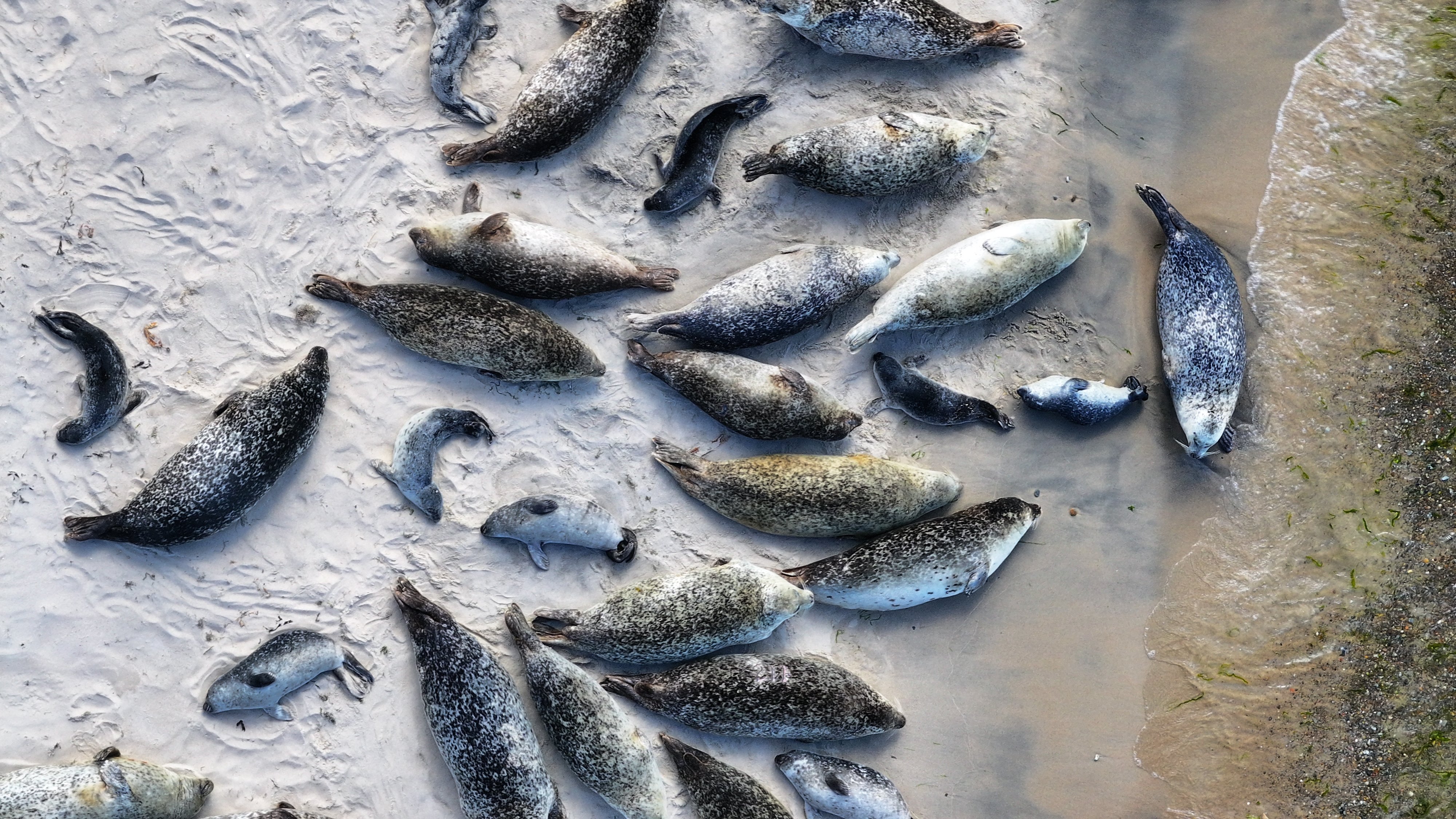
“Disturbance from humans is another known problem,” says Goldsborough, though its exact effect on the seals is difficult to ascertain. Out on the North Sea, which van Dijk describes as the “dining room” to the Wadden Sea’s “bedroom” for harbor seals, the animals are exposed to noise pollution from ships, wind farms and oil and gas fields. Meanwhile, back on the sandbanks of the Wadden Sea, they face pressures from recreational tourism, including activities like boat tours and guided low-tide hikes, known as “wadlopen,” across the exposed seabed. In June, a severely weakened pup was found hiding between two parked cars at an illegal beachside party. Nursed back to health at Pieterburen, the seal, given the name Rave, was released in October.
The chronic stress caused by these and other disturbances could take a toll on the seals’ physical and reproductive health, though a direct correlation has yet to be proved. As Rubio-Garcia explains, seals that end up in rehab are already stressed out by the rehabilitation experience itself—what with being taken from their natural habitat and surrounded by humans—making it difficult to gauge their baseline stress levels in the wild.
At the moment, the likeliest hypothesis seems to be food availability. Weterings notes that herring and flatfish, major components of the harbor seal’s varied diet, are threatened by overfishing and rising sea temperatures. He also points to detrimental effects of the European Union’s landing obligation, a directive that prohibits fisheries from releasing bycatch back into the ocean. Implemented to reduce waste and incentivize more selective fishing practices, the directive has had the adverse effect, according to Weterings, of “removing a lot of biomass from the ecosystem.”
The food hypothesis appears to be supported by an ongoing study by Wageningen Marine Research, which began in March 2025 and involved tagging six harbor seals with trackers to monitor their movement in the North Sea. “So far,” says Goldsborough, “these trackers indicate that the seals are spending much longer periods of time at sea and venturing farther away from the shore than they used to—at least, compared to older data. This could mean that food availability is running low and that they have to travel farther in search of nourishment.” For some pups, this extended search—which exposes them to exhaustion, predation and entanglement—could well prove deadly.
This would also explain why they don’t wash up on the shore. “Seals that are sick and can’t feed themselves come to the coast,” says Sophie Brasseur, a marine mammal researcher at Wageningen closely involved with annual seal counts. “But seals that aren’t sick can travel 100 kilometers [62 miles] per day. If they die, they die looking for food, and that’s in the middle of the North Sea, far from land.”
To better understand population dynamics, the consortium hopes to find ways to improve the gathering, sharing and assessment of seal-related data. Because seal research and conservation in the Wadden Sea encompass both private and public institutions spread across the Netherlands, Germany and Denmark—as well as various disciplines and economic sectors—information is not always made readily available to everyone involved. As a result, says Goldsborough, each individual stakeholder has a different, incomplete picture of what’s going on. Genuine synthesis, resulting from open collaboration, could reveal answers that would otherwise remain hidden.
In the Netherlands, some researchers worry that potentially valuable data goes uncollected and unused. Weterings recalls stumbling upon a dead seal during a beach walk last fall, its carcass all but decomposed. “There were no maggots anymore, no smell,” he recalls. “Just a piece of leather in the vague shape of a pup.” No one had come to pick it up, let alone examine it—not for lack of interest, he says, but because the infrastructure needed to make that happen is missing, unlike with other, more threatened species, like the harbor porpoise.
To explore whether citizen science platforms can fill this knowledge gap, the consortium has reached out to Stranding.nl, a popular Dutch website where users can share photos, locations and descriptions of stranded animals. Provided that the entries’ quality and accuracy are properly evaluated—possibly with the help of artificial intelligence—such websites could, according to Goldsborough, be turned into research-appropriate databases.
Once researchers have figured out why the seals are disappearing—be it food or disturbance or something else entirely—conservationists will need to figure out what can be done about it. Currently, it’s still somewhat unclear whether the problem belongs to the Wadden Sea or the adjacent North Sea. “The media often frames this as a local issue,” says van Dijk, returning to his oft-used metaphor: “For all we know, though, this issue might belong to the dining room, not the bedroom.”
This lack of answers makes solving the mystery all the more pressing. Seals are bioindicators; they reflect the health of their broader ecosystems, and their well-being affects species up and down the food chain they are part of.
At the end of it all, the consortium—set to conclude this year—might find that the disappearing seals were just a blip in the data, rather than a long-term trend. But with the fate of the ecosystem on the line, investigators say they have no choice but to operate under the assumption that something is wrong. Precaution, they say, is not a luxury so much as a necessity. “If we waited until we knew with absolute certainty that this was not a natural fluctuation in the population,” stresses Weterings, “then we’d already be too late.”