Why ending duty-free treatment for $800 shipments is straining fashion sourcing
The indefinite suspension of duty-free treatment for low-value shipments, effective June 2026, is forcing fashion retailers to rethink supply chains and pricing for small orders.
On June 24, 2026, U.S. Customs and Border Protection indefinitely suspended the de minimis exemption, a rule dating to 1938 that allowed shipments valued at $800 or less to enter the United States duty-free and with minimal paperwork. The suspension applies to all modes of importation from all countries, taking effect ahead of a statute Congress had already set to terminate the exemption permanently on July 1, 2027. CBP processed over 1.36 billion de minimis shipments in fiscal year 2024 alone; by eliminating duty-free treatment for low-value imports, the suspension reshapes economics for retailers that built supply chains around shipping small quantities across borders.
For fashion and apparel retailers, the change creates two immediate pressures: a surge in compliance costs and new tariff bills on orders that previously avoided duties. The impact falls hardest on direct-to-consumer brands, smaller e-commerce players, and European shippers, which historically relied on the exemption to keep shipping costs low. Larger retailers with established customs infrastructure and domestic sourcing absorb the change more easily. Understanding what changed, and for whom, is essential as retailers recalibrate sourcing, pricing and fulfillment strategies through the end of 2026 and beyond.
How the suspension changed entry requirements
Before June 24, 2026, retailers could ship apparel and accessories in parcels under $800 without filing customs entries, posting bonds, or paying duties. CBP collected no revenue from these transactions and required minimal data. The exemption streamlined logistics for small orders and made cross-border e-commerce viable for lower-margin products.
The suspension eliminates this path entirely. All non-postal shipments under $800 now require formal or informal customs entry. Postal shipments valued at $2,500 or less follow a separate process: designated filers must submit monthly Excel spreadsheets with detailed shipment data, including 10-digit Harmonized Tariff Schedule classifications, merchandise descriptions, and bond numbers, and pay duties via Pay.gov by the 7th of the following month, no longer collected upon delivery.
Retailers without Importer of Record status must hire a licensed customs broker or designate a broker as the filer. Small brands and dropshippers without in-house customs expertise now face a structural barrier: they cannot file entries themselves. The compliance burden has shifted from CBP to the importer, who must now maintain accurate product data, tariff codes, and commercial invoicing for every shipment.
De minimis suspension timeline
CBP indefinitely suspended the de minimis exemption on June 24, 2026, for all non-postal shipments. A separate postal informal entry process took effect July 24, 2026. The suspension applies to all countries and all merchandise valued at $800 or less, ahead of the statutory deadline Congress set for July 1, 2027.
The financial impact: duties, bonds and surcharges
Under the old regime, a $400 shipment of apparel from Italy faced no tariffs or processing fees. Today, the same shipment is subject to import duties, a customs bond requirement and CBP processing fees, which either cut into retailer margins or require raising prices.
Postal carriers are compounding the cost. Royal Mail and other carriers have restricted cross-border e-commerce deliveries and introduced handling surcharges for customs-eligible packages. These surcharges were absorbed in the old exemption model but now appear as line-item costs. One major fashion brand reported that more than 10 percent of its sales were previously covered by the de minimis exemption; those same orders are now subject to a 30 percent tariff.
Lululemon, the Canadian activewear brand, disclosed that tariffs on U.S. imports rose from $240 million in 2025 to an expected $320 million in 2026. While Lululemon manufactures at a larger scale than most apparel retailers, the magnitude illustrates how broad the price pressure has become across the industry.
Which fashion retailers feel the suspension most
Direct-to-consumer (D2C) brands shipping from Europe have absorbed the sharpest blow. European fashion houses, jewelers and accessories makers historically shipped small inventory parcels to U.S. warehouses or fulfilled individual customer orders via international mail. De minimis treatment made this model economical. Removing it forces a choice: absorb tariffs and surcharges, raise prices to cover them, or build U.S. inventory through larger, scheduled shipments that qualify for different duty rates.
Smaller e-commerce retailers and marketplace sellers face an additional constraint: many lack the financial scale or compliance infrastructure to negotiate volume discounts from customs brokers, obtain surety bonds efficiently, or maintain the data systems now required. A small apparel startup shipping from Germany cannot absorb the added per-package costs without passing them to customers or cutting product lines entirely.
Large, established retailers with dedicated customs and compliance teams absorb the change more readily. They can shift sourcing through nearshoring, bonded warehousing or foreign trade zones to manage customs costs. They can consolidate shipments to reduce per-unit compliance costs. They can adjust pricing gradually without disrupting customer acquisition. Mid-market D2C brands and smaller importers lack these levers and face margin compression or customer churn if they raise prices significantly.
One major fashion brand reported that more than 10 percent of its sales were previously covered by the de minimis exemption; those same orders are now subject to a 30 percent tariff.
Fulfillment strategies under pressure
The suspension is forcing retailers to redesign fulfillment networks. Brands that once shipped customer orders directly from Europe to U.S. addresses now face incentives to build U.S. warehouses, contract with domestic fulfillment centers, or shift to domestic sourcing. These changes require capital investment and longer lead times, reducing the agility that made D2C brands competitive.
Some retailers are consolidating shipments to reach quantity thresholds where per-unit compliance costs decline and alternative entry procedures become accessible. Others are raising minimum order values to spread compliance costs across larger transactions. A few brands are reconsidering their geographic strategy, narrowing U.S. operations or pivoting to markets where low-value shipments remain exempt.
Postal carriers have signaled that the era of cheap international parcel delivery is over. Royal Mail and other national carriers are limiting cross-border e-commerce services, imposing surcharges, and requiring pre-clearance. This removes one of the last low-cost pathways for small-shipment international commerce and further incentivizes retailers to consolidate inventory and shift fulfillment inland.
What CBP said justified the suspension
CBP cited three rationales for suspending the exemption: revenue protection, security, and consumer safety. The agency noted that low-value shipments grew from about 139 million annually in fiscal year 2015 to more than 1 billion by fiscal year 2023, a more than 600 percent increase, and to over 1.36 billion in fiscal year 2024, an almost tenfold rise from 2015. In a January 2025 statement announcing CBP’s proposed rule to tighten the exemption, then-Secretary of Homeland Security Alejandro Mayorkas said the exemption “has undermined American businesses and workers” and “flooded our ports of entry with foreign-made products.” The suspension moves revenue collection earlier in the supply chain and increases CBP’s visibility into shipment composition and origin.
CBP also emphasized drug interdiction and counterfeiting concerns. Fentanyl and other synthetic drugs enter the U.S. partly through low-value parcels that evade scrutiny due to their volume. Counterfeit goods similarly exploit the exemption to avoid inspection. By requiring 10-digit tariff codes and detailed declarations for all low-value shipments, CBP gains data to target higher-risk imports and detect misclassification.
These justifications operate independently of the statutory framework Congress created. The statute scheduled de minimis to expire July 1, 2027, reflecting a legislative process. CBP instead relied on its own long-standing discretionary authority to suspend the exemption indefinitely ahead of that date. The agency characterized its action as protecting revenue and security, not as a tariff increase.
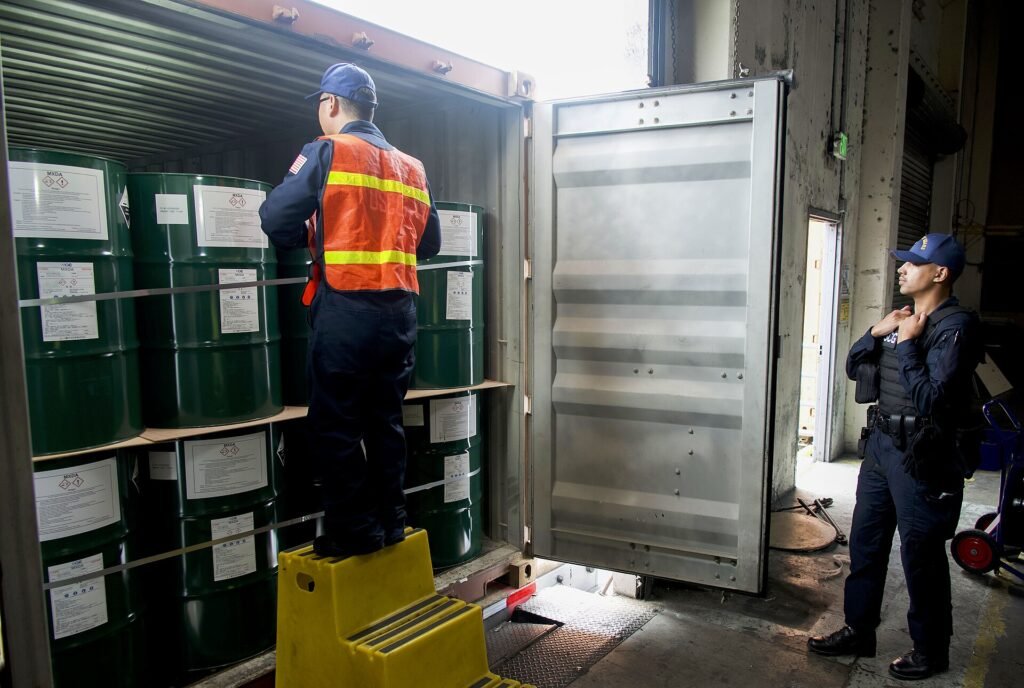
Photo: U.S. Coast Guard photo by Petty Officer 1st Class J.J. Huggins · Public domain · via Wikimedia Commons