Why Hermès and Stella McCartney Are Betting on Mycelium Leather
Fungal-based alternatives replace toxic chrome tanning with a two- to three-week fermentation process.
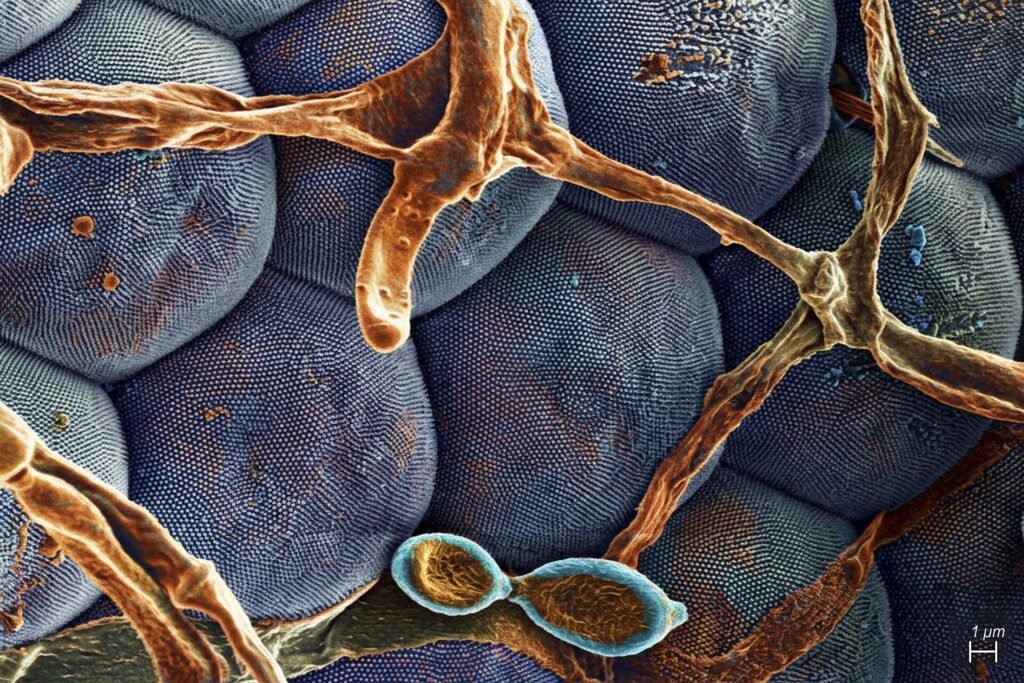
Mycelium leather grows from fungus. The process starts with agricultural and industrial waste—sawdust, straw, corn stalks—that serves as food for fungal colonies. As the mycelium develops, its branching threads fuse into a foam-like material that can be flattened into sheets resembling leather, without the toxic chromium baths used in traditional tanning. Growing the mycelium from substrate takes two to three weeks.
The speed and cleanliness of the process have attracted major fashion houses. Hermès introduced the first luxury product from the technology in March 2021, in partnership with MycoWorks. Since then, Alexander McQueen, Ralph Lauren and Stella McCartney have launched collections using mycelium or competing mycelium-adjacent materials. A $125 million Series C funding round announced by MycoWorks in January 2022 reflects investor confidence that the technology can eventually scale beyond proof of concept to mass production, with initial capacity targeted at several million square feet annually.
Substrate, Fermentation and Growth
Mycelium leather production begins with substrate selection. Manufacturers source industrial byproducts and agricultural waste—sawdust, straw, corn stalks—that serve as food for fungal colonies. The mycelium is then cultivated as either a biological tissue or mat on top of a liquid or solid substrate, or as fungal biomass in submerged liquid fermentation. Both methods involve growing the fungus under controlled conditions.
Growing conditions are controlled with precision. Researchers testing different approaches used a paste-based substrate that combined advantages of submerged and solid fermentation methods, testing fungal species including Ganoderma lucidum, commonly known as reishi mushroom, and Pleurotus djamor, the pink oyster mushroom. The controlled paste formulation allowed growers to produce thicker mycelial mats over a shorter period than traditional nutrient-enriched agar or liquid culture methods. The stronger mats could be harvested by peeling rather than cutting, improving production efficiency.
Other producers use different substrates. Bolt Threads, which developed the Mylo material, uses industrial byproducts such as sawdust as food for its fungus.
MycoWorks’ South Carolina Expansion
MycoWorks announced construction of a manufacturing facility in Union, South Carolina in January 2022, expected to become operational within 12 months and produce several million square feet of Fine Mycelium per year. The $125 million Series C funding supported this facility as the company moves beyond luxury applications toward mass-scale production.
From Fungal Mat to Finished Material
As the mycelium develops, its branching threads fuse to each other, eventually growing into a solid, foam-like material. Mushroom leather is made by flattening this foam into a fabric that mimics the texture and flexibility of traditional leather. Some producers engineer the mycelium during growth to produce a stronger and more durable final product. The material can be customized by adjusting growth conditions, substrate composition and post-harvest treatment.
The speed of mycelium leather production is among its primary advantages. Traditional animal leather requires six to eight weeks of tanning and processing, involving multiple chemical baths. Mycelium-based alternatives are grown in two to three weeks depending on the mushroom species and growing conditions. Because mycelium naturally self-organizes its structure during growth, minimal additional processing is required to achieve durability comparable to conventional leather.
The finished material can be dyed, treated and finished similarly to traditional leather, allowing designers to create textures and aesthetics familiar to luxury consumers. MycoWorks’ Fine Mycelium platform was used in the Hermès collaboration that introduced mycelium leather to the luxury market.
Environmental Advantages Over Traditional Leather
Mycelium leather’s environmental profile differs sharply from both animal leather and petroleum-based synthetics. Traditional animal leather production is water-intensive and chemically demanding. Cattle farming uses almost 30% of the world’s ice-free land and freshwater, while animal agriculture produces 20% of global greenhouse gas emissions. The tanning process for animal leather requires chemical dyes and toxic treatments including chromium, which causes environmental contamination near tanneries and can damage liver, kidney and lung tissue.
Mycelium leather requires significantly less water, and early assessments suggest it produces very little greenhouse gas emissions to grow. The production process uses post-consumer agricultural waste like corn stems and wood chips as substrate, which would otherwise be discarded. Once grown, the material is 100% biodegradable and can become organic fertilizer, embodying circular economy principles unlike conventional leather which requires intensive resource extraction and toxic processing.
The material also avoids the chemical pollution associated with synthetic alternatives. Petroleum-based synthetic leathers require long degradation periods and carry potential off-gassing risks. Mycelium leather from producers like MycoWorks and Bolt Threads eliminates the need for harmful chemicals that can pollute soil, water and air near traditional tanneries.
Hermès and the Luxury Market Entry
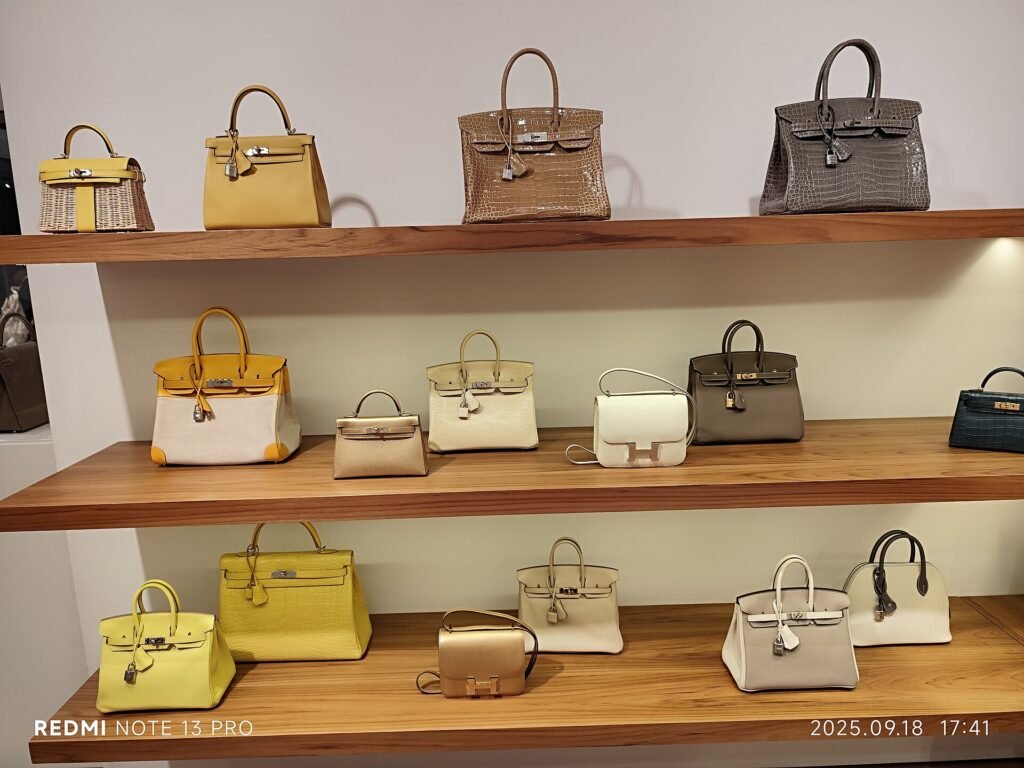
In March 2021, Hermès announced a partnership with MycoWorks on a product made with the company’s Fine Mycelium material, which MycoWorks markets as Reishi, signaling that a house synonymous with traditional leather craftsmanship was willing to experiment with fungal alternatives at a product level. The partnership validated MycoWorks’ technology within the luxury sector.
MycoWorks’ credibility within the industry increased sharply following this collaboration. Patrick Thomas, the former chief executive of Hermès, joined MycoWorks’ board in July 2021, shortly after the product launch. The appointment from someone with deep luxury manufacturing expertise underscored the seriousness with which the industry viewed the technology’s potential. Hermès’ endorsement signaled to other luxury houses that mycelium leather was no longer merely experimental.
Mycelium leather requires almost no energy to grow and appears to generate very little greenhouse gas emissions, whereas animal agriculture produces 20% of global emissions and requires intensive water use and toxic chemical tanning.
Competing Approaches and Brand Expansion
MycoWorks is not the only company pursuing mycelium-based alternatives. Bolt Threads developed Mylo, a competing mycelium-based material made using sawdust as substrate. Adidas showed interest in the material, and Stella McCartney adopted it for her first mushroom-leather bag in 2022. However, Bolt Threads paused Mylo production in 2023, illustrating the capital intensity required to move from prototype to production.
Other companies are pursuing different bio-based approaches. Natural Fiber Welding produces MIRUM, made from agri-waste and natural rubber, which has been adopted by luxury houses including Alexander McQueen and Ralph Lauren. Stella McCartney has released MIRUM handbags in recent years and established an early commitment to alternative materials, having previously sold over a million Falabella bags in its leather-free style since 2009. The diversity of approaches—mycelium-based, agri-waste composites, and other alternatives—indicates the luxury industry is exploring multiple technologies simultaneously rather than betting on a single material.
Scaling From Proof of Concept to Mass Production
The central challenge facing mycelium leather is manufacturing scale. Laboratory batches and small-run luxury collections represent proof of concept, but reaching commercially viable production requires substantial capital investment in facilities and infrastructure. In January 2022, MycoWorks announced a $125 million Series C funding round led by Prime Movers Lab, with participation from SK Networks, Mirabaud Lifestyle Impact and Innovation Fund and other existing and new investors. This Series C brought total funding for MycoWorks to $187 million.
MycoWorks deployed the Series C capital toward building a new manufacturing plant in Union, South Carolina, with operations expected to begin within 12 months of the January 2022 announcement and an initial annual capacity of several million square feet of Fine Mycelium. CEO Matt Scullin articulated the company’s dual strategy: while currently serving luxury brands like Hermès, the goal was to move toward mass-scale production that would enable products at a range of price points beyond the premium market.
The investment signals that mycelium leather companies believe they can eventually compete on cost and scale, not merely on sustainability credentials. A successful South Carolina facility would reduce per-unit production costs and enable brands to use mycelium leather across broader product categories beyond luxury accessories into mainstream fashion. However, the pause in Bolt Threads’ Mylo production demonstrates that capital and manufacturing scale remain substantial barriers for the sector.
Regulatory Drivers and Market Timeline
Beyond brand preference for sustainability, regulatory pressure in Europe is creating timeline pressure on luxury houses to adopt traceable sustainable alternatives. The European Union’s Digital Product Passport regulation will require brands to disclose precise material composition and environmental performance data for all apparel and footwear products sold on the EU market, regardless of where the brand is based or its size. The delegated act for textiles is expected to be shared in 2027, with fashion brands receiving at least 18 months from that point to implement the requirements.
The Digital Product Passport is expected to require disclosure of material composition, manufacturing processes, core environmental indicators, chemical compliance, traceability and durability. Mycelium leather’s shorter production cycle, lower water use, minimal chemical processing and biodegradability give it substantial advantages in meeting these transparency requirements compared to traditional leather or synthetic alternatives.
This regulatory timeline aligns with production capacity expansion. Brands have already committed to partnerships or pilot collections with mycelium producers. As manufacturing scales through MycoWorks’ South Carolina facility and other producers expand capacity, and as the EU’s transparency mandate approaches its 2027-2029 implementation window, luxury houses are positioned to shift from experimental partnerships to commercial product lines. The combination of environmental benefits, regulatory pressure and demonstrated demand from brands creates momentum for the technology’s continued growth.
Photo: Brandon Antonio Segura Torres & Priscilla Vieto Bonilla · CC BY-SA 4.0 · via Wikimedia Commons