Only 7 Percent of Discarded Clothing Qualifies as Textile Recycling Feedstock
Mechanical and chemical recycling processes can turn old garments into new fibers.
The world discards 120 million metric tons of clothing each year. Of that, 80 percent ends up in landfills or incinerators, 12 percent is reused, and less than 1 percent is recycled into new textile fibers. The math narrows further: only about 7 percent of all discarded textiles are actually suitable feedstock for textile-to-textile recycling, which means the vast majority of clothing that could theoretically be recovered never reaches a processing facility.
The barriers are technical, economic, and logistical. Fiber blends, dyes, and collection infrastructure all work against recovery. Yet the industry is beginning to shift. New mechanical and chemical recycling methods are being deployed at scale, and regulatory pressure—particularly in California and the European Union—is forcing producers to rethink how garments move through the system.
What mechanical and chemical recycling actually do
As of 2023, synthetic fibers dominated textile production: polyester and nylon accounted for 68 percent of global fiber output, compared with 21 percent for cotton. That concentration matters because both polyester and nylon can be recycled, at least in theory.
Mechanical recycling shreds and re-spins garments into new yarn without chemically altering the fiber. It is the simplest and least expensive method, but it has a critical flaw: the repeated shearing and processing degrades fiber length and strength. The resulting material is typically downgraded into lower-quality applications like insulation or padding rather than new garments. Mechanical recycling also cannot remove dyes or separate fiber blends.
Chemical recycling breaks fibers down into their molecular building blocks through depolymerization, which uses technologies such as glycolysis to chemically disassemble the polymer into monomer components that can be used to produce new resin. Chemical recycling can handle colorants, additives, and finishing materials—a decisive advantage over mechanical recycling. It produces fibers with “performance capabilities substantially equivalent to virgin polyester fibers.” But chemical processes require more energy, more processing steps, and more capital investment than mechanical methods.
In practice, neither approach is mature at commercial scale. Mechanical recycling dominates existing infrastructure because it is cheaper, but its output is too degraded for most new apparel. Chemical recycling is growing—companies including Syre and Reju have opened or announced facilities—yet production volumes remain small. The industry appears to be converging on a hybrid future: mechanical recycling for lower-grade products, chemical recycling for fiber-to-fiber recovery.
The value lost each year
The global fashion industry discards $150 billion in raw material value annually through textile waste. Recovering even a quarter of these resources could offset the combined annual material spending of the world’s 30 largest fashion companies.
Why fiber blends and dyes stop most garments from being recycled
Here is where the system breaks down. Most modern fabrics are blends of different fiber types—often combinations of natural and synthetic materials such as cotton, polyester, and elastane—and most existing industrial recycling solutions, which are primarily mechanical, can handle only single-material textiles. Elastane, also called spandex, is nearly impossible to separate from the other fibers once it’s blended in, and pulling fabrics apart by component material is costly and labor-intensive.
Blends of polyester, cotton, and elastane—common in casual wear—are even more problematic. Mechanical recycling lacks any way to separate these fibers; chemical recycling has shown promise for handling blended textile waste, but the process becomes more complex and expensive as more fiber types are combined.
Dyes present a related obstacle. Mechanical recycling cannot remove dyes from fiber, while some chemical recycling processes, such as glycolysis, can filter dyestuffs and other contaminants out during processing. The EU’s draft recyclability scoring for the Digital Product Passport treats dyes, along with prints, coatings and sequins, as “recycling disruptors” that lower a garment’s score.
The result is a perverse sorting problem: garments are sorted into categories like “mixed textiles” or “blended fabrics” so broad that they offer no clear path to any specific recycling process. Most of what gets collected is too contaminated, too blended, or too degraded to be worth processing into new fibers.
How collection and producer responsibility are beginning to address scale
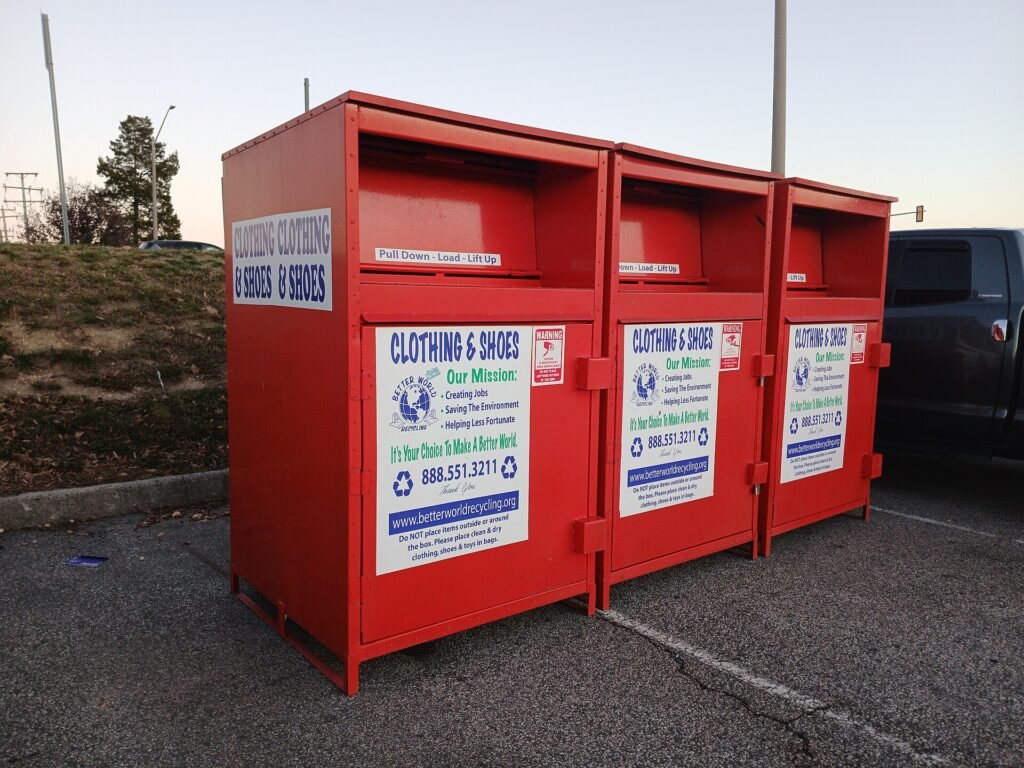
Recycling is partly a logistics problem. Garments must be collected, sorted, and transported to processing facilities. Most U.S. cities have no formal textile collection infrastructure beyond donation centers and thrift stores. Textile waste ends up in curbside recycling bins, where it gets tangled in sorting equipment, or is sent to landfill.
California took the first regulatory step in the U.S. when it enacted the Responsible Textile Recovery Act (SB 707) in 2024. The law is the first extended producer responsibility scheme for textiles in the United States. Under the law, producers of apparel and textile articles sold in California—except secondhand sellers and companies with less than $1 million in annual global sales—must fund and participate in a recovery program. Producers were required to join a Producer Responsibility Organization by July 1, 2026; the state’s implementing regulations are set to take effect no earlier than July 1, 2028, with full rollout by July 1, 2030.
SB 707 shifts the financial burden to producers, which is expected to incentivize investment in collection infrastructure and sorting technology. Whether this model scales to other states remains to be seen, but the law signals that U.S. policymakers are beginning to view textile waste as a producer responsibility rather than a consumer disposal problem.
Elastane is nearly impossible to separate from the fibers it’s blended with, and most existing industrial recycling processes can handle only single-material textiles.
What the EU’s Digital Product Passport means for traceability
The European Union is pursuing a different angle: transparency. The Ecodesign for Sustainable Products Regulation (ESPR) includes a Digital Product Passport (DPP) for textiles, approved in June 2024. Under the DPP, each garment will carry a QR code linked to a digital record of its fiber composition, durability scores, manufacturing location, recycled content percentage, and end-of-life guidance.
The delegated act specifying DPP requirements for textiles is expected in 2027, with an 18-month transition period. Most brands should expect compliance by 2028 onward. The passport is not a recycling mandate, but it serves as a prerequisite: recyclers cannot effectively separate and process fibers without knowing what those fibers are.
In theory, DPPs make the sorting and recycling process more efficient. A sorting facility equipped with QR code readers could route each garment to the appropriate recycling stream. In practice, the passport creates a new data burden on producers. The information required—fiber composition from suppliers, production locations, dye chemistry, durability test results—often does not exist in centralized form, especially for brands that source from multiple suppliers.
Why the recycling rate remains stubbornly low
The recycling rate for textiles into new garments remains stubbornly low because the system was never designed for recovery. Garments are engineered for durability and aesthetics, not disassembly. Fiber blends are chosen for performance without regard to recyclability. Collection infrastructure barely exists. And the economics of recycling—the cost of sorting, processing, and fiber recovery—make recycled fibers more expensive than virgin polyester, which is cheap because it is made from oil.
The $150 billion in raw material value lost annually through textile waste represents an economic opportunity. But capturing that value requires addressing all three barriers simultaneously: designing garments with simpler fiber compositions, investing in collection networks, and building processing capacity at scale. The textile recycling industry hasn’t yet attracted the funding needed to scale operations to industrial levels, and the incentives to accelerate are only beginning to align.
Photo: Ser Amantio di Nicolao · CC BY-SA 4.0 · via Wikimedia Commons