Section 301 duties on 60 economies began July 24 as the Section 122 surcharge expired
Forced-labor duties on 60 economies took effect July 24 as the Section 122 surcharge expired.
Apparel and footwear importers now deal with two separate federal duty issues. At the same time, a temporary 10 percent global surcharge under Section 122 expired on July 24, 2026, and new Section 301 duties on 60 economies took effect the same day.
This explainer sets out the rates, exclusions and refund filing steps as four law-firm and tax-advisory pages describe them, and marks where those sources are silent or disagree. The Federal Register notice, the USTR text and CBP’s own guidance were not opened, so the figures are secondary summaries.
What expired on July 24 and what replaced it
The Section 122 duties were a temporary additional duty of 10 percent applied globally, and they were set to expire on July 24, 2026. Baker Donelson describes them as having expired automatically. USTR announced its final Section 301 action on July 23, following determinations made on June 2, 2026.
The new duties apply to covered goods entered for consumption, or withdrawn from warehouse for consumption, from 12:01 a.m. Eastern Time on July 24. Baker Donelson says they stay in place indefinitely unless amended. EY says the duties take effect as the Section 122 tariffs are set to expire.
A limited in-transit exception covers goods loaded at the port of loading and in transit on the final mode before 12:01 a.m. Eastern on July 24. Those goods are excluded if they are entered for consumption, or withdrawn from warehouse for consumption, before 12:01 a.m. Eastern on July 28. Clark Hill says the test turns on entry timing and loading status, not on arrival by July 28.
CAPE launch date
CBP was to launch Phase 1 of the CAPE refund tool inside ACE on April 20, 2026, and each declaration can list up to 9,999 entries.
Country rates for the 60 covered economies
The action covers 60 economies in two additional-duty tiers. EY places 19 economies at 10 percent, counting the European Union and Taiwan, and 41 at 12.5 percent, counting Japan, South Korea and Switzerland.
The 10 percent group named in the sources includes Bangladesh, Cambodia, Indonesia, Malaysia, India, Mexico, Canada and the United Kingdom, along with Argentina, Ecuador, El Salvador, Guatemala, Honduras, Jordan, Pakistan, Sri Lanka and Trinidad and Tobago. The 12.5 percent group includes China, Vietnam, Thailand, the Philippines and Türkiye, along with Australia, Brazil, Israel, Singapore, South Africa and the United Arab Emirates.
For the blended economies, the EU and Taiwan pay no additional duty where the general rate is already 10 percent or more. Where it is lower, the combined rate is brought up to 10 percent. Japan, South Korea and Switzerland follow the same approach with a 12.5 percent target. Clark Hill says this treatment applies only to products that are not otherwise exempt.
The sources describe the basis for the tiers differently. Clark Hill says the 10 percent rate rests on a forced-labor import prohibition, an ART commitment to impose and enforce one, or a partial prohibition regime. Baker Donelson says countries that fail to impose a ban face 12.5 percent, and countries that impose one without effective enforcement face 10 percent. Clark Hill also says 54 economies were found to have failed to impose and effectively enforce such prohibitions. It also names six economies that had adopted prohibitions but did not enforce them effectively: Canada, Ecuador, the EU, Indonesia, Mexico and Pakistan. None of the pages read explains how that count maps onto the tier lists.
Quotas for textiles and apparel, and the Section 232 exclusion
USTR plans tariff-rate quotas for textile and apparel goods from Bangladesh, Cambodia, Indonesia and Malaysia. Each quota has an initial three-year term and is tied to that country’s imports of U.S. cotton and textile inputs. EY says the aim is to promote U.S.-origin textile inputs and reduce reliance on higher-risk sources. Baker Donelson says that once a quota is operational, a set volume of textile and apparel goods can enter free of the Section 301 tariff.
The sources do not give start dates for these quotas. They are to be set in a later Federal Register notice. Until each quota starts, the standard 10 percent rate applies to the covered textile and apparel goods from those four countries.
Goods already subject to Section 232 tariffs are excluded from the Section 301 action. EY says the new duties generally will not stack with Section 232 measures. Baker Donelson lists the Section 232 categories as steel, aluminum, copper, automobiles and parts, medium and heavy-duty vehicles and parts, lumber products and semiconductor articles. That list does not include apparel or footwear.
Other exclusions cover informational materials, donations, accompanied baggage, and products listed in Annexes I and II to the Federal Register notice, some of which are economy-specific. EY lists the reasons for product exemptions, including raw materials whose domestic supply could be disrupted and products not available in sufficient U.S. quantities.
Baker Donelson lists further exemptions that largely match those used under IEEPA and Section 122. They include certain pharmaceuticals, civil aircraft and parts, certain tropical agricultural products, and Canadian and Mexican goods entering duty-free under USMCA. Textile and apparel goods from Costa Rica, the Dominican Republic, El Salvador, Guatemala, Honduras and Nicaragua can enter duty-free under DR-CAFTA.
None of the four sources read for this story addresses footwear under the new Section 301 action.
Where footwear and China duties remain unsettled
None of the four sources read for this story addresses footwear under the new Section 301 action. Those that cover the tariffs describe rates by economy but do not state a footwear rate from any origin.
For China, the new action sets a 12.5 percent additional duty, and Baker Donelson says the Section 301 tariff applies on top of the item’s MFN rate. The sources read for this story do not address whether any other duties apply to Chinese goods on top of the new rate.
How importers file for IEEPA refunds through CAPE
CBP was to launch Phase 1 of its refund tool, CAPE, inside the Automated Commercial Environment (ACE) on April 20, 2026. Herrick, Feinstein LLP’s alert of April 17, 2026 summarizes the guidance. It recommends February 1, 2025 as a conservative starting point for pulling data, and February 23, 2026 as the outer-bound end date because collection of ad valorem IEEPA duties ceased then.
Before filing, a filer confirms ACE access and that its ACH refund banking information is current. That banking information is separate from existing payment details. The filer pulls ACE data for February 1, 2025 through February 23, 2026, identifies entries with at least one dutiable IEEPA Chapter 99 code, and separates out excluded entries.
The filer then uploads a CSV file through the CAPE tab in ACE, listing the entries in a CAPE Declaration. Each declaration can list up to 9,999 entries, so the alert recommends grouping entries, confirming numbers and removing duplicates before upload.
ACE checks the upload first. A file that fails authorization or format checks is rejected in full. Each entry is then checked to confirm it exists in ACE and carries at least one dutiable IEEPA Chapter 99 code. Failed entries are rejected individually while the rest proceed, so filers can correct and resubmit.
For accepted entries, ACE removes the dutiable IEEPA Chapter 99 codes and duties from the entry summary lines and recalculates duties. After CBP review, the entries are liquidated or reliquidated, and a refund is issued after that. The alert gives no refund timeline.
Phase 1 covers most unliquidated entries and entries up to 80 days past liquidation. It also covers entries under suspension, extension or review, and warehouse entries. It excludes entries flagged for reconciliation, drawback claims, entries with an open protest, entries with final liquidation, and entries not filed in ACE or lacking a liquidation status there. Certain antidumping and countervailing duty scenarios pending liquidation are also excluded. The exclusions are reserved for later phases, which the alert does not date.
The alert does not state deadlines for protests or Court of International Trade litigation. It says those options should be assessed within the applicable deadlines, and it points to CBP’s April 2026 Quick Reference Guide for CAPE Declarations.
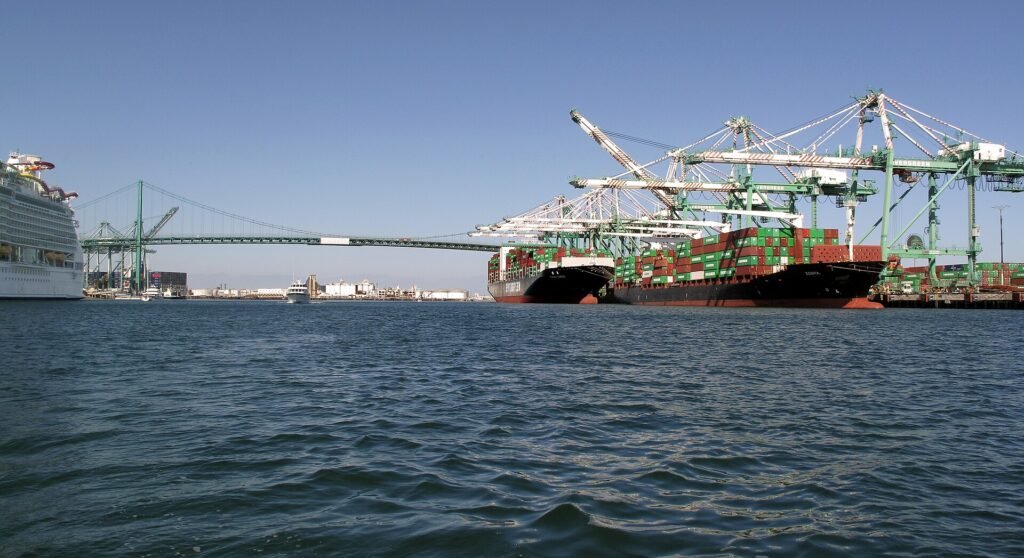
Photo: Downtowngal · CC BY-SA 4.0 · via Wikimedia Commons